The Book
Das Buch
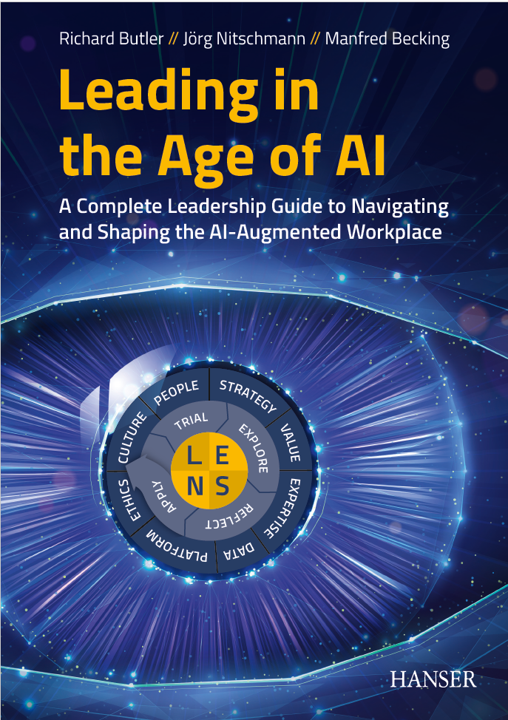
Leading in the Age of AI
A Complete Leadership Guide to Navigating and Shaping the AI-Augmented Workplace.
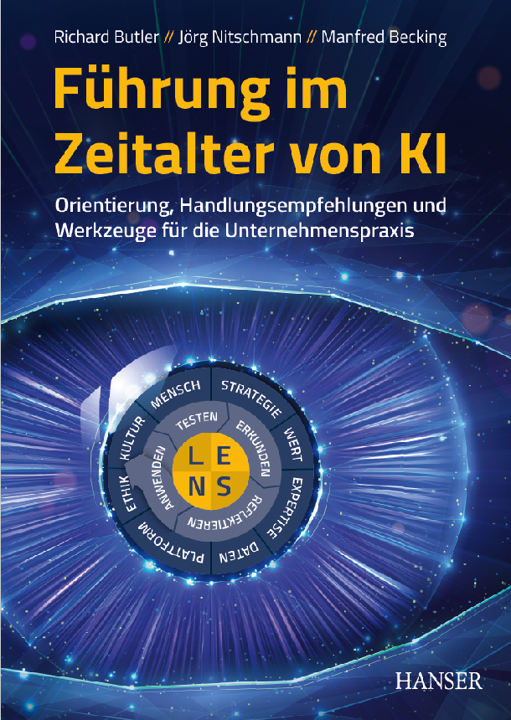
Führung im Zeitalter von KI
Orientierung, Handlungsempfehlungen und Werkzeuge für die Unternehmenspraxis.


Order the book
Buch bestellen
What getAbstract says
"Successfully introducing AI is far more than a technical challenge: it affects strategy, corporate culture, collaboration, and ethics in equal measure."
"Richard Butler, Manfred Becking, and Jörg Nitschmann explain in practical terms how leaders can weigh opportunities and risks, bring employees along, and build a learning organisation."
"Its structured presentation, concrete tools, and practical recommendations make the book a valuable guide."
"The point is to understand AI well enough to lead with confidence, clarity, and conviction in a rapidly changing environment."
"The TERA cycle helps you use AI critically: Test, Explore, Reflect, Apply."
"Transformation is never complete. It is a continuous process of making sense and adapting."
Extracts from the getAbstract review. Read the full summary on getAbstract →
Das sagt getAbstract
„Die erfolgreiche Einführung von KI ist weit mehr als eine technische Herausforderung: Sie betrifft Strategie, Unternehmenskultur, Zusammenarbeit und Ethik gleichermaßen.“
„Richard Butler, Manfred Becking und Jörg Nitschmann erklären praxisnah, wie Führungskräfte Chancen und Risiken abwägen, Mitarbeitende mitnehmen und eine lernfähige Organisation aufbauen können.“
„Die strukturierte Aufbereitung sowie konkrete Werkzeuge und Handlungsempfehlungen machen das Buch zu einer wertvollen Orientierungshilfe.“
„Es geht darum, sich ausreichend mit KI auszukennen, um in einem sich schnell verändernden Umfeld mit Zuversicht, Klarheit und Überzeugung führen zu können.“
„Der TERA-Zyklus hilft Ihnen, KI kritisch zu nutzen: Testen, Erkunden, Reflektieren, Anwenden.“
„Die Transformation ist niemals abgeschlossen. Sie ist ein fortwährender Prozess der Sinnfindung und Anpassung.“
Auszüge aus der getAbstract-Rezension. Vollständige Zusammenfassung bei getAbstract lesen →
Why this book
This is an invaluable guide for leaders in the age of artificial intelligence, offering practical guidance, recommendations for action, and tools for business practice. It provides in-depth knowledge, clear strategies, and actionable tools to strategically leverage the opportunities of the technology, consciously manage risks, and actively shape the transformation.
The book focuses not on the systems themselves, but on the fundamental mechanisms of AI. Using proven methods and established models of thought, it offers guidance that remains valid even after the next technological leap — a lasting guide that helps you understand, classify, and responsibly shape the mechanisms of AI-supported leadership.
The frameworks
The authors present their own frameworks that provide orientation in the GenAI jungle: TERA-LENS, a role-specific procedural model tailored to AI transformation, and the CLEAR model, designed for developing personal leadership competencies.
These frameworks help organizations start step-by-step with manageable experiments, learn from them, reflect on their results, and then scale successful approaches.
Who it is for
The book is written for managers and practitioners exploring how to integrate AI into business processes and leadership tasks — and no prior knowledge of AI is required. It gives a comprehensive overview of the fundamental mechanisms of AI and their application in business management, with concrete instructions and practical tools to build new skills and foster team potential.
What sets it apart
A particular strength of the book lies in its timeless relevance. Rather than focusing on current AI systems, it addresses the fundamental mechanisms of AI, so the work remains valid even after the next technological leap. The authors combine their experience in leadership, organizational development, and AI integration to bridge the gap between technological progress and human-centered leadership.
The authors
Richard Butler is a co-founder of Rimagin GmbH and the initiator of the German-speaking SAFe Meetup community. He supports organizations in building flexible structures and modern leadership approaches in complex systems, with a particular focus on the role of AI.
Jörg Nitschmann is the managing director of Jörg Nitschmann Solutions and a certified AI-Native Trainer with Scaled Agile. He advises companies on strategy development, agile transformation, and change management in the context of artificial intelligence.
Manfred Becking, also a co-founder of Rimagin GmbH, helps organizations effectively align strategic goals, work processes, and leadership behavior — especially in the interplay between new ways of working and new technologies.
What readers say (Amazon)
★★★★★
The cream of the crop in AI
A real must-read. The authors don't just know the theory; they have spent years successfully guiding real-world transformation processes. A practical guide packed with concrete examples — for me, already the definitive reference work on AI transformations.
— Rene Schrader-Boelsche
★★★★★
Not just the usual hype. Truly useful.
What convinced me was the section on the actual costs of AI. The breakdown of where value is truly created versus where it is merely assumed has given me a clearer way to formulate the questions I should ask when someone approaches me with an AI business case.
— peterS
★★★★★
Accessible and practical
I thought I was already quite knowledgeable about AI, but this book really opened my eyes. It showed me — in a simple, accessible way — how to use AI more efficiently. I now work with AI in a much more structured and effective way.
— MA
★★★★★
A very good introduction to AI
Part 1 is a fantastic introduction to AI. I finally understand all the buzzwords — LLMs, SLMs, multimodal systems, RAG, automation — all grounded in real-world use cases rather than just theory. For the first time, I felt like I truly understood what AI actually is.
— krümel
Warum dieses Buch
Ein wertvoller Leitfaden für Führungskräfte im Zeitalter der Künstlichen Intelligenz: Er bietet praxisorientierte Orientierung, Handlungsempfehlungen und Werkzeuge für die Unternehmenspraxis. Er vermittelt fundiertes Wissen, klare Strategien und umsetzbare Tools, um die Chancen der Technologie gezielt zu nutzen, Risiken bewusst zu steuern und die Transformation aktiv zu gestalten.
Das Buch stellt nicht die Systeme selbst, sondern die grundlegenden Mechanismen von KI in den Mittelpunkt. Mit erprobten Methoden und bewährten Denkmodellen bietet es Orientierung, die auch nach dem nächsten technologischen Sprung gültig bleibt — ein dauerhafter Leitfaden, der hilft, die Grundmechanismen von KI-gestützter Führung zu verstehen, einzuordnen und verantwortungsvoll zu gestalten.
Die Frameworks
Die Autoren stellen eigene Frameworks vor, die Orientierung im GenAI-Dschungel geben: TERA-LENS, ein rollenspezifisch auf die AI-Transformation abgestimmtes Vorgehensmodell, und das CLEAR-Modell, das für die Entwicklung persönlicher Führungs-Kompetenzen maßgeschneidert ist.
Diese Frameworks helfen Organisationen, Schritt für Schritt mit überschaubaren Experimenten zu starten, daraus zu lernen und zu reflektieren und dann erfolgreiche Ansätze zu skalieren.
Die Frameworks entdecken und die kostenlosen Canvases nutzen →
Für wen es ist
Das Buch richtet sich an Manager und Praktiker, die die Integration von Künstlicher Intelligenz in Geschäftsprozesse und Managementaufgaben erkunden möchten — Vorkenntnisse im Bereich KI sind nicht erforderlich. Es bietet eine umfassende Einführung in die grundlegenden Mechanismen von KI und deren Anwendung in der Unternehmensführung, mit konkreten Handlungsanleitungen und praxisnahen Arbeitshilfen, um neue Kompetenzen aufzubauen und Potenziale im Team zu fördern.
Was es auszeichnet
Ein besonderer Mehrwert liegt in der zeitübergreifenden Relevanz. Statt aktueller KI-Systeme stehen die grundlegenden Mechanismen von KI im Mittelpunkt, sodass das Werk auch nach dem nächsten technologischen Sprung gültig bleibt. Die Autoren kombinieren ihre Erfahrungen aus Leadership, Organisationsentwicklung und KI-Integration, um eine Brücke zwischen technologischem Fortschritt und menschlich orientierter Führung zu schaffen.
Die Autoren
Richard Butler ist Mitgründer der Rimagin GmbH und Initiator der deutschsprachigen SAFe Meetup-Community. Er unterstützt Organisationen beim Aufbau flexibler Strukturen und moderner Führungsansätze in komplexen Systemen, insbesondere im Hinblick auf die Rolle von KI.
Jörg Nitschmann ist Geschäftsführer von Jörg Nitschmann Solutions und zertifizierter AI-Native Trainer bei Scaled Agile. Er berät Unternehmen zu Strategieentwicklung, agiler Transformation und Change-Management im Kontext von Künstlicher Intelligenz.
Manfred Becking, ebenfalls Mitgründer der Rimagin GmbH, unterstützt Organisationen dabei, strategische Ziele, Arbeitsprozesse und Führungsverhalten effektiv aufeinander abzustimmen — insbesondere im Zusammenspiel von neuen Arbeitsweisen und neuen Technologien.
Das sagen Leser (Amazon)
★★★★★
Das Gelbe vom AI. Ich liebe dieses Buch.
Ein echtes Muss. Die Autoren kennen sich nicht nur theoretisch aus, sondern haben jahrelang echte Transformationsprozesse erfolgreich begleitet. Ein praxisnaher Leitfaden voll konkreter Beispiele — für mich schon jetzt das Standardwerk für KI-Transformationen.
— Rene Schrader-Boelsche
★★★★★
Kein üblicher Hype. Wirklich nützlich.
Überzeugt hat mich der Abschnitt über die tatsächlichen Kosten von KI. Die Aufschlüsselung, wo Wert wirklich geschaffen wird und wo er nur angenommen wird, hat mir einen klareren Weg gegeben, die richtigen Fragen zu einem KI-Business-Case zu stellen.
— peterS
★★★★★
Verständlich und guter Bezug zur Praxis
Ich dachte, ich kenne mich mit KI schon gut aus — dieses Buch hat mir an mehreren Stellen die Augen geöffnet. Es zeigt einfach und verständlich, wie ich KI effizienter nutzen kann. Ich arbeite jetzt deutlich strukturierter und effektiver mit KI.
— MA
★★★★★
Eine sehr gute Einführung in KI
Teil 1 ist eine großartige Einführung in KI. Endlich verstehe ich die ganzen Buzzwords — LLMs, SLMs, multimodale Systeme, RAG, Automatisierungen — und das alles in realen Anwendungsfällen verankert statt in reiner Theorie.
— krümel